

What if you learned to read the landscape around you?
For several months, we have been working in partnership with Danièle from Notre Nature au Fil des Saisons on a project that is particularly close to our hearts: to better understand the landscapes and biodiversity surrounding the Moulin de Babel.
Trained in observing wild plants and using bio-indicator plants, Danièle is accompanying us on a five-year project dedicated to studying the soils and environments around the Mill. This approach is based in particular on the methodology developed by Gérard Ducerf and ethnobotany.
Several initiatives have arisen from this partnership, including a floristic inventory of the site and the wild plant discovery outings that we are offering you today. In the coming years, this work will also give rise to other activities related to wild plants, their uses and cooking.
Walks suitable for the people present
Every weekend in June and July, we offer small group tours to discover the plants around the Mill.
These outputs are based on two main complementary areas.
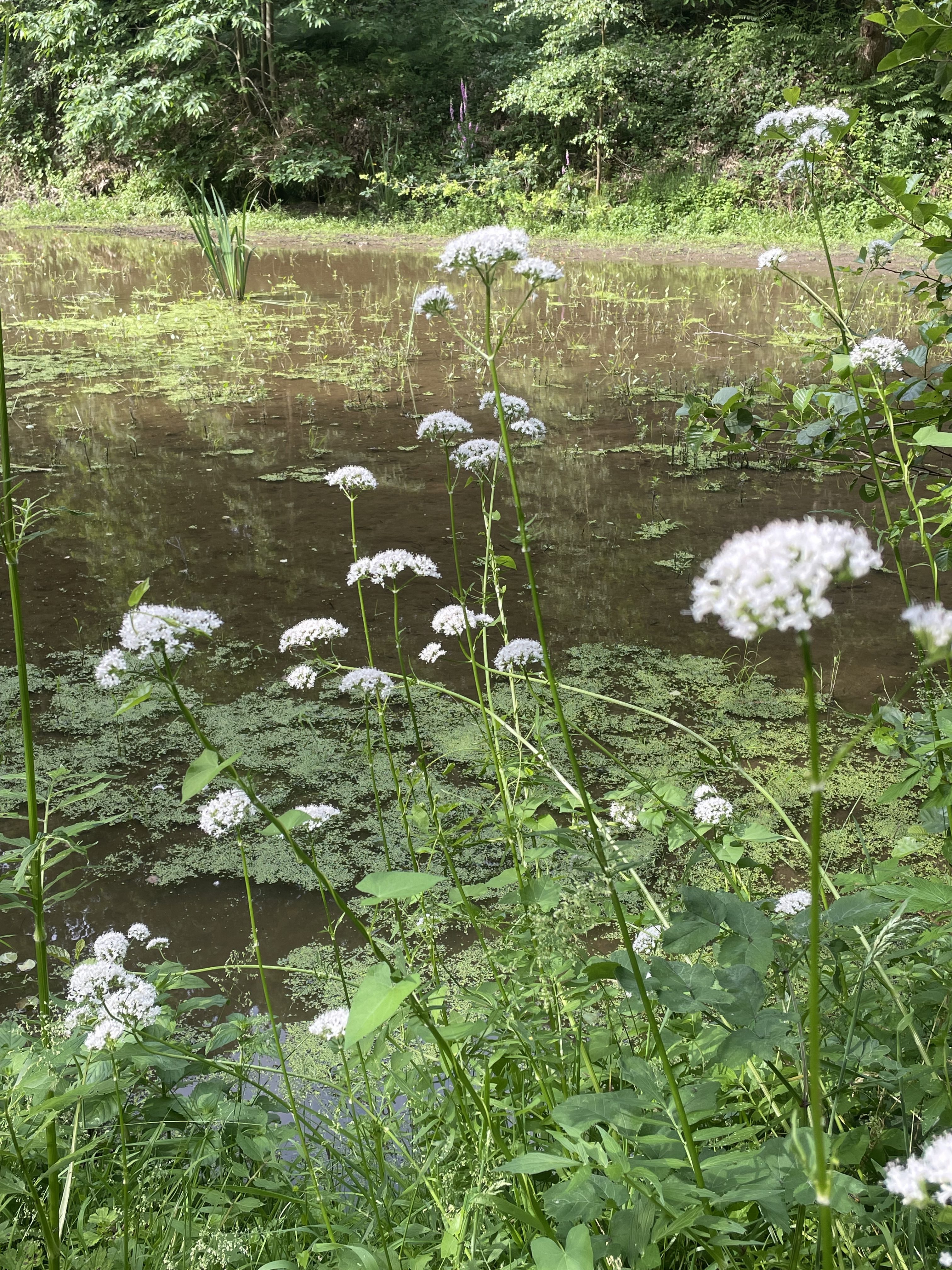
The first involves learning to observe plants in their environment: understanding their role in ecosystems, their relationships with insects, soils, water, and even the history of landscapes.
The second aims to acquire identification methods that allow plants to be recognised with greater autonomy through observation, flora guides or specialised apps.
But these contents do not constitute a fixed programme.
Each outing is built around the people present, their expectations, their level of knowledge, the questions that arise during the walk and, of course, the discoveries we make on the ground.
A different outing with children
A botanical walk doesn't quite happen in the same way when children are involved.
And it's often excellent news
Younger children generally approach nature with a spontaneous curiosity that turns an outing into a genuine treasure hunt. Looking for a particular flower, observing leaf shapes, recognising a scent, or finding a plant they've encountered before quickly becomes a life-sized treasure hunt.
The objective remains the same: to learn to observe. But the way to achieve this naturally adapts to the group, so that everyone can find their place and enjoy the discovery.
Learning to look differently
These outings are designed as special occasions, accessible to beginners and yet in-depth enough to satisfy those already interested in botany.
Above all, we aim to learn to look at our surroundings differently.
Because behind plants that we sometimes pass every day without paying attention, lie stories, uses, complex relationships with living things, and often a better understanding of the landscapes we inhabit.
As we wander, we hope to offer a few tips for observing nature more closely, as well as the desire to continue exploring on your own once you get home.
Summer 2026 release dates
Opening hours: 9:45 AM to 12:00 PM
- Saturday 13 June
- Sunday 14 June
- Saturday 20 June
- Sunday 21 June
- Sunday 28 June
- Saturday 11 July
- Sunday 12 July
- Saturday 18 July
- Sunday 19 July
- Saturday 29 August
- Sunday 30 August
- Saturday 5th September
- Sunday 6 September
- Sunday 13 September
Practical information
Free and conscious participation.
You will be given an e-booklet of this type at the end of each outing.
Here is the link to view it: https://heyzine.com/flip-book/dd37437a53.html
Ensure you bring footwear suitable for sometimes wet paths.
Long sleeves and trousers are recommended to limit the risk of ticks.
Activity accessible without prior knowledge.
For any questions or registration, contact Danièle by text on 07 66 10 01 06 (we will call you back).
Other dates may be offered depending on demand.